Showing posts with label Magento2. Show all posts

Tuesday, May 29, 2018

Buried Treasure Fossil achieves 2X revenues by focusing on Magento store Maintenance

“Having the site page and product opening performance restored is great news. Thanks to Sigma and the team. I received 4 orders in the past 4 hours.”
– Gary Greaser
Owner, BTF
Buried Treasure Fossil is the place for new and seasoned fossil collectors, providing a wide range of incredible fossils to choose from. As a purely online business, BTF strategy is to offer great fossils at great prices, and super service for customers across the USA. The relatively young company is owned by Gary Greaser, an avid enthusiast, and collector of the fossils. Having realized that migrating to Magento Opensource from Magento 1.7 could enable him to boost his sales while delivering an excellent customer experience, Gary chose Sigma to migrate their site to Magento Opensource which was completed and went live in 4 months.
The team worked hard to ensure that all features and functionally made it easier for customers to navigate through the site. Some of the enhancements like Featured Category on the homepage and filtration of the fossils by species enabled customers to find what they need in half the time that was required earlier. By using landing pages for product categories, customers could see all relevant information about a specific fossil on the product page, and add it directly to their cart.
Present Business Need

Launching an e-commerce site takes a lot of work, and so does effectively supporting, maintaining, and evolving it. Proactive maintenance, site updates and applying security patches are a critical part of managing an e-commerce site.
As with many companies, Buried Treasure Fossil does not have the in-house tech team to keep a modern e-commerce site running effectively and securely while the business is growing. To bridge this gap, Sigma is responsible for keeping their site running optimally – both from a technology and a marketing perspective.

Support and Maintenance

The team defines and prioritizes the site updates, functional improvements, patches and site issues when they arise. For every task, we have a turn around time of 4 to 8 hrs. We track these changes and issues within our issue tracking tool – JIRA, assign a unique tracking number to each task and get them done. We have regular status calls and generate weekly reports in order to track the progress of all support issues and to ensure the process is being followed and most importantly, expectations are being met.

Sigma’s client support activities include a combination of the following activities:
  • Ongoing website maintenance
  • Troubleshooting for technical issues
  • Magento training to clients hold of their Magento store
  • Performance improvement
  • Website speed optimization
  • Feature up gradation and installations
  • Security patch updates
  • Suggestions and solutions for improved search engine ranking
  • Solution to the server or hosting related problems
  • Daily status reports and weekly progress reports
Sigma Magento Experts are always ready for any kind of Magento support and maintenance. We work as the client’s go-to experts and help them with up-gradation of software and improved functionality with new and updated features in the E-commerce website.
Based on customer requirements and hourly support they need, we offer customized Magento maintenance and support monthly packages. We discuss clients’ requirements and agree with them for a particular number of hours per month and make a schedule as per their suitability to catch up during business hours through telephonic, email, chat, video chat and face to face support.

Friday, April 27, 2018

Top 5 Magento Enterprise Edition Features – 2018 - Sigma Infosolutions


A good number of small scale and medium scale businesses prefer the Magento Community Edition for being budget friendly but the Magento Enterprise Edition is built for the development of a rapid and cost-effective innovation in the long run. The platform uses a combination of rich, out-of-the-box functionality, enterprise performance and powerful business tools to get ahead of increasingly complex commerce operations and growing customer demands.
Let us take a look at some of the Magento Enterprise features—
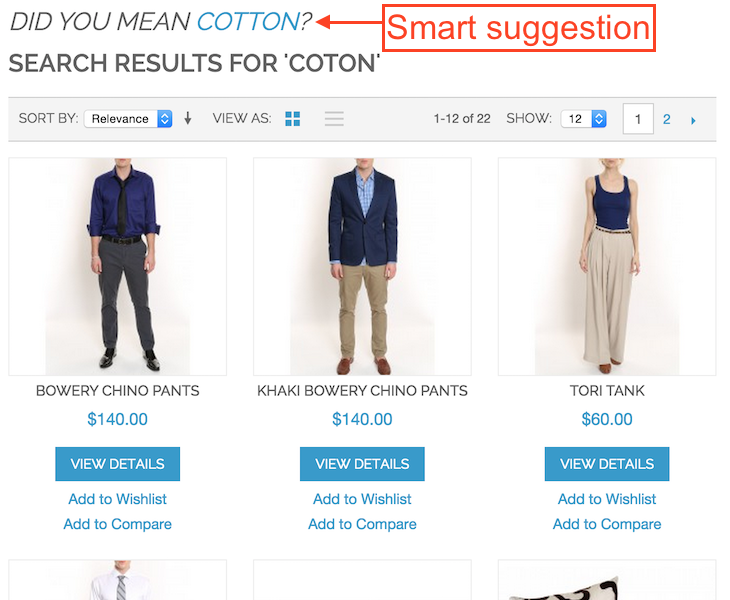
1. Advanced Search –Magento Enterprise Edition includes Elastic Search for the most powerful customer search experience, with advanced search rules that deliver the results your customers expect. Magento 2 EEs Elastic search comes with powerful features such as
  1. Automatic suggestion for better user experience (aka “Did you mean?” feature)
  2. Very fast autocomplete
  3. Smart correction when text query is misspelled
  4. Search for product attribute options
And much more.
2. Advanced Targeting and Segmentation tools – Magento 2 Enterprise Edition has an interesting feature that allows you to dynamically display content and promotions to specific customers, based on properties such as customer address, order history, shopping cart contents and so on.You can also optimize marketing initiatives based on targeted segments by using shopping cart price rules and banners. Because customer segment information is dynamic and is constantly refreshed, customers can become associated and disassociated from a segment as they continue shopping from the online store.
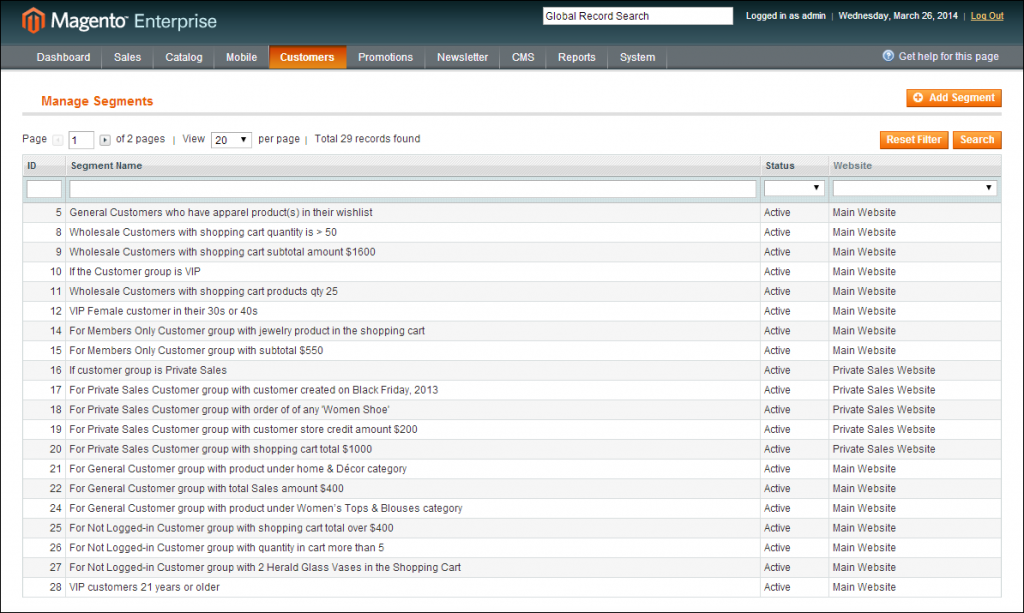
This boosts the conversion rate for the business and creates a unique shopping experience for their customers, promising more potential ones.
3. Advanced Merchandising and Promotion –Grabbing a customer’s attention is an expensive task. Once you have got it, the next challenge is how do you show your customers the right products and promotions to increase your chances of making a sale? Merchandising and promotion are great tools to increase conversion rates. Drag and drop merchandising, flexible pricing and promotions, rules-based cross-sales and up-sales, and customer segmentation tools are all features of Magento Enterprise Edition that help you automate creative strategies for maximizing customer sales.
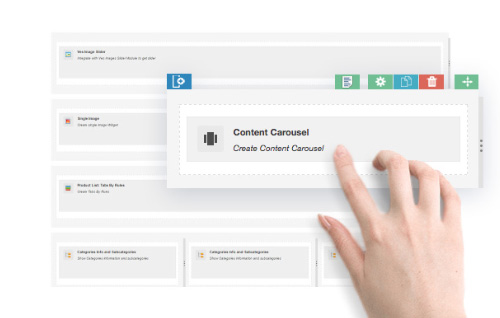
4. Advanced Content Management –Integrating third-party CMS solutions to your Magento build adds cost and complexity. Magento 2 Enterprise Edition includes drag-and-drop content management capability with staging and preview features that allow your content creators to build content and get it approved without involving a developer.
5. B2B Support –Business-to-business eCommerce is growing. Companies are working on their B2B eCommerce strategy, increasing the competition. Many companies are using an obsolete custom-built eCommerce platform, or don’t have one at all. A proper eCommerce platform for B2B allows your business to grow by giving smaller customers an opportunity to self-service, allowing you to focus on higher-value customers. Magento’s B2B functionality includes requisition lists, quotes, negotiated pricing, product exclusivity, and corporate accounts. These built-in features allow you to focus on customizing the features that are unique to your business operation.
While Magento 2 has an affordable Community plan perfect for small businesses, companies who are serious about e-Commerce or drive high revenue are encouraged to invest in Magento 2 Enterprise.
It offers different payment methods for you and your customers. You can download these as extensions to your Magento account for different Magento Enterprise pricing options. These include:
Amazon Pay: You can integrate Amazon Pay into your Magento account.
Apple Pay: Your customers can easily purchase your products through their iOS device or on their Apple ID.
Google Wallet: You can accept payments from your customer’s Google accounts and from the card they have saved in their Google Wallet.
Bitcoin and Altcoins: Because of its security and effectiveness, more digital consumers are choosing bitcoins and altcoins as payment methods. Accepting bitcoins and altcoins can help your store attract these consumers.
PayPal: This payment service is by far the most widely used because of its efficiency and safety. PayPal is also great for international shoppers.
These extension options and add-ons will help you appeal to a wider audience while also benefitting you in terms of gaining revenue. It is important to identify the right platform based on your business needs. Magento Enterprise Edition allows the businesses to build a well-designed, responsive and secure website, enabling the owner to control the web store efficiently in order to scale up their online marketing game.

Monday, January 8, 2018

Going headless with Magento

The Headless CMS architecture is steadily rising in popularity. This model allows completely custom user experiences while providing developers the great flexibility to innovate. It also helps website owners to future-proof their builds by allowing them to update the design without re-implementing the whole CMS. With all this upside, it’s no wonder this type of build has gained serious traction in Magento community off late.

It may be a tad hard to understand why this is needed or what it actually involves. Let’s get little deeper into figuring what and how. The headless Magento will run on original Magento application, but the application is not outputting anything to the browser.
Let’s take a product listing example. In the HTML page, you could create placeholders for the products so that every product looks similar. Then each product would be fetched one-by-one by JavaScript remotely and replace the placeholder. Applying the same principle to the checkout or customer pages would also require a push of data back to the Magento server.
Why go headless with Magento?
One of the benefits is that JavaScript is loosely coupled with Magento backend and which JavaScript framework to use would become a frontend developers choice, instead of KnockoutJS being now a solid requirement for developing in Magento.
Also, this would mean that there is no need for Magento developer’s to worry about designing on Magento. Instead, the focus can be on a REST API that simply offers everything that needs to be loaded. Magento provides a flexible framework that can be used to build custom logic on pricing, logins, checkout, etc. However, this contains a lot of additional stuff that is not needed. Building your own pricing rules might be easier than trying to extend and modify the Magento pricing rule system. It might require effort. But you will be dumping a lot of complex logic, in favor of code that simply works the way you want it to work.
Challenges of going headless on Magento
Cost of implementing headless approach with Magento
One of the biggest challenges of headless Magento applications is replacing the full presentation stack of Magento is not a trivial task. One of the strategies is to only replace key pages of a site such as home page, product navigation, and browsing, basically focusing on the navigation and discovery experience. In such strategies, other pages such as checkout or order history are left untouched. Another strategy is to replace the whole presentation tier. The cost of the two approaches is very different.
So a key decision is a value of replacing the Magento presentation tier. Each merchant needs to consider that trade-off. A part of the value of the Adobe and Acquia partnerships is that much of this integration effort is being solved up front, removing that overhead per site. But in general, headless strategies at present will be a higher cost than using the native Magento presentation tier
Using extensions with Magento
In Magento, extensions can plug themselves into the default Magento pages using the Magento layout engine. A key design goal of Magento is that you can purchase an extension and have it “just work”.
Extensions can be back-end oriented (e.g. a different tax calculation engine, a different promotions engine, etc). These extensions have minimal or no change in the consumer experience (presentation tier) and so are easy to add to a headless Magento installation.
The problem occurs for the extensions that enhance the presentation tier. Address verification, smarter merchandising, a search extension with auto-complete – extensions frequently inject additional JavaScript into a site to provide a better consumer experience. Injecting JavaScript into the Magento presentation tier does not help a headless deployment. If a headless Magento installation manually merges JavaScript from extensions into its code base, care must be taken to correctly apply future patches provided with that extension.
In Conclusion
By shifting responsibility for the user experience completely to the browser, the headless model provides a number of benefits such as:
  1.  It allows the site owner to redesign the site without re-implementing the CMS
  2. It gives frontend specialists full control over the user experience using their native tools.
  3. Speeds up the site by shifting display logic to the client-side and streamlining the backend. An application focused on delivering content can be much more responsive than one that assembles completely formatted responses based on complex rules.
  4. Builds true interactive experiences for users by using the website to powerfully function in-browser applications. The backend becomes the system of record and “state machine”, but back-and-forth interaction happens real-time in the browser.
  5. Headless website development has the potential to unleash the creative power of frontend developers to deliver richer, faster, and more responsive user experiences.
Is “headless Magento” a major strategic direction for the future? That would be overstating it. But it is a valid use case that Magento will continue to support.

Monday, November 6, 2017

How Magento Makes you Festival Ready


The last quarter is undeniably the busiest season of the year for every e-commerce retailer as the beginning of festival sales opens the channel for growth and surplus sales to ramp up revenues and build up your customer base. Letting your website exist as it is, hoping that your e-commerce site gets all the needed attention by itself will not allow you to be a part of the festival league. Having a pre-planned and tested strategy is the only fool-proof method that can tide you through the season with customers having seamless and hassle-free shopping experience to choose you over your competitors and return back for more without any second thoughts.
After all, the first impression is indeed the best impression. According to Statista and the National Retail Federation, the holiday season accounts for around 20% of the retail industry’s annual sales and can account for as much as 30% of an individual retailer’s total sales. The shopping days beginning from Black Friday through Christmas pulls in almost 50-100% more revenues than any other shopping periods during the normal course of the year. E-commerce retailers can enhance their website’s presence and visibility by getting into the following practices for ramping up their sales this season:
  • Integrating the rating module using Magento’s development tools can aid with building a trust factor with the customers by enabling them to view the previous reviews. Trusting a 100% online portal depends purely on the feedback of its regular users.
  • Hiring a Magento developer to take care of all your social media promotions. Today world is highly driven by the opinions and promotions on social media. Cashing in on this platform to regulate one’s business requires proper integration of sources and captivating marketing.
  • Keeping the e-commerce site’s social pages buzzing with the season’s celebrations by promoting contests, offering freebies, etc, will definitely drive the traffic of the website and definitely regulate sales if the expectations of the customers are visually appealing and fairly priced.
  • Customizing using Magento themes and installing google analytics into the e-commerce platform will the business to thrive by building upon sales via promotion of these commonly sought after products which are advertised extensively through the internet.
  • Build the brand by displaying all laurels won by the e-commerce platform. This helps the customer to know that your e-commerce platform is also free from scams and establish yourself as a genuine customer portal.
  • Keep the promotional offers interesting. One size does not fit all, and there should be good incentives that will drive your customer for more purchases rather than being bored with just a few promotional offers on repeat. Getting creative and enabling these promotions through Magento’s tools will prove effective.
  • Integrating SMS API will enable text promotion which will be driving factors for sales in last-minute shoppers looking for sales at the closing. Last minute offers are always tempting to the customer and this method of promotion is the fastest since most of the population is hooked to the phone.
  • Having an in-house Magento developer will be beneficial, especially during the festive season, because the developer will be able to constantly update and keep track of the website’s progress for zero-downtime sales.
While these pointers are sales boosters, some of the other preparatory steps to take note of to boost the holiday performance include; theme modifications, working payment portals, responsive customer service team, upgraded server capacity, device compatibility for apps, customization offers portal, including accurate product descriptions with product videos, and a interactive homepage with top brand lists based on customer trends.
Software Development Blogs - BlogCatalog Blog Directory RSS Search Technology Blogs - Blog Rankings Blog Directory